NY CDPAP Guide 2026: Navigating the PPL Fiscal Intermediary Transition
An essential guide for NY CDPAP consumers and caregivers. Learn about the 2025 PPL transition deadlines, new eligibility rules, and standard wage rates.
The New York Consumer Directed Personal Assistance Program (CDPAP) is undergoing the most significant structural upheaval in its history. For years, consumers could choose from over 600 Fiscal Intermediaries (FIs) to administer their care. That era is over.
The state has mandated a transition to a single Statewide Fiscal Intermediary (SFI): Public Partnerships LLC (PPL). This consolidation, combined with tightened eligibility requirements effective late 2025, has left thousands of families scrambling for clarity.1
This guide cuts through the noise of litigation and confusion to provide a definitive survival operational plan for the 2025–2026 transition. If you are a CDPAP consumer or a Personal Assistant (PA), specific deadlines apply to you right now.
Key Takeaways
- PPL is the Sole FI: All 600+ legacy FIs are being eliminated or demoted. Public Partnerships LLC (PPL) is now the sole employer of record for all CDPAP caregivers.1
- Critical Deadlines: Consumers must complete registration by August 1, 2025. Personal Assistants must register by August 15, 2025 to ensure pay continuity.2
- New Eligibility Rules: Effective September 1, 2025, new applicants must require assistance with three Activities of Daily Living (ADLs), or two if diagnosed with dementia.3
- Wage Standardization: PPL has standardized base wages regionally, ranging from $18.10 to $20.10 per hour.1
- Facilitators vs. FIs: Your old FI may stay on as a "Facilitator" to help with paperwork, but they can no longer process payroll.1
Executive Summary: What is Changing?
CDPAP allows Medicaid recipients to hire their own caregivers—including family members and friends—granting them "Employer Authority."3 Historically, third-party agencies (Fiscal Intermediaries) handled the payroll.
However, arguing that the system was rife with administrative waste, New York State has centralized all backend operations under PPL. While litigation delayed this rollout initially, the courts have allowed the transition to proceed with strict timelines.4
1. The Single FI Transition (PPL)
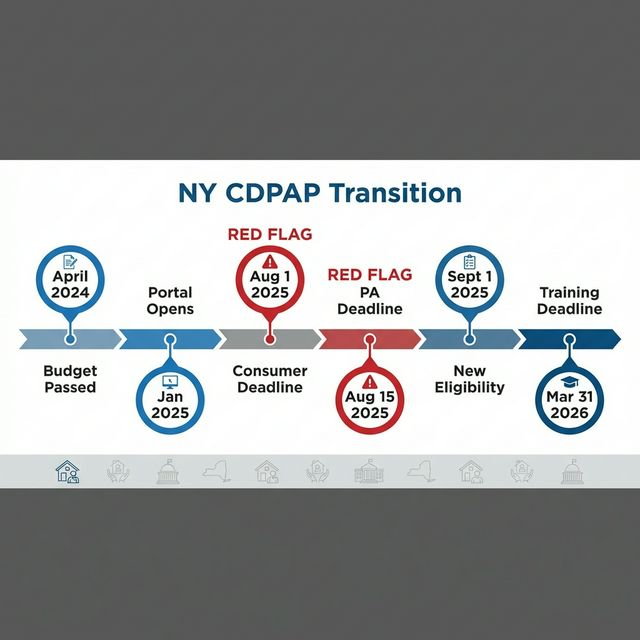
The immediate impact is the transfer of employer responsibilities. You no longer have the choice to "shop around" for an FI that offers better benefits or faster processing. PPL is now the monopoly provider for backend administration.
Hard Deadlines for 2025
To prevent a disruption in care or payment, you must adhere to the following schedule:2
- August 1, 2025: Consumer Deadline. All existing CDPAP consumers must have initiated their transition profile in the PPL portal.
- August 15, 2025: Personal Assistant (PA) Deadline. All caregivers must be fully registered, including I-9 verification, in the PPL system.
Warning: Failure to meet these dates puts your PA's paycheck at risk. PPL has indicated that manual timesheet processing will be available during a grace period, but delays are expected.5
2. The Redefined Role of "Facilitators"
Many consumers are loyal to their local Independent Living Centers (ILCs) or agencies. The good news is that some of these organizations remain involved as "Facilitators."
- Old Role (Fiscal Intermediary): Processed payroll, set wages, managed benefits, held insurance.
- New Role (Facilitator): Subcontractors to PPL. They assist you with enrollment forms, Electronic Visit Verification (EVV) troubleshooting, and navigating the PPL portal.1
They cannot cut checks or override PPL's policies. Think of them as your local customer support agents for the statewide PPL system.6
3. Updated Eligibility & Minimum Needs
Perhaps the most controversial change is the tightening of medical eligibility.
Effective September 1, 2025, the "Minimum Needs Requirement" changes.3
- Standard Requirement: An individual must require physical assistance with at least three (3) Activities of Daily Living (e.g., toileting, transferring, feeding).
- Dementia Exception: Individuals with a diagnosis of Alzheimer's or related dementia involved in the start of care must require assistance with at least two (2) ADLs.7
This is a higher bar than the previous "medical necessity" standard, potentially disqualifying individuals with lower-level needs who use CDPAP for instrumental activities like shopping or cleaning.3
4. Operational Changes for Personal Assistants
For your caregivers, the transition to PPL means new onboarding and training requirements.
Wage Structure
Wages are no longer variable by agency. PPL utilizes a regionally tiered base wage:1
- Downstate (NYC, Long Island, Westchester): ~$20.10/hour
- Rest of State: ~$18.10/hour
Mandatory Training
By March 31, 2026, all PAs must complete mandatory training via the Nevvon portal (integrated with PPL). This covers fraud prevention, EVV compliance, and basic care safety.2
Medical Requirements
All PAs must maintain an updated health assessment, including TB screening and proof of Rubella/Rubeola immunity.1 PPL has stated they will strictly enforce these blocks on payroll if documents expire.
5. Scam Awareness
Transitions create opportunities for bad actors. Consumers have reported receiving calls from "compliance officers" demanding social security numbers to "save their spot" in CDPAP.
- Official Verification: PPL and your Local Department of Social Services (LDSS) will never ask for payment to register.1
- Trust Only: Communications from
pplfirst.comor official mail from the NYS Department of Health.
Frequently Asked Questions (FAQ)
1. Can I keep my current Personal Assistant?
Yes. The PPL transition does not force you to fire your PA. However, your PA must re-apply and be hired by PPL as the new employer of record.1
2. Will my PA's pay go down?
It depends. If your previous FI paid significantly above the Medicaid reimbursement floor to attract workers, your PA might see a wage stabilization to the new PPL regional standard usage. If you were at the minimum, you might see a slight increase.1
3. What if I miss the August 1 deadline?
You risk a gap coverage. While the state has mentioned "continuity of care" protocols, the administrative backend will be switched off for legacy FIs. You should contact PPL immediately to late-register.8
4. Does PPL offer a physical office I can visit?
PPL primarily operates remotely but has established regional support centers. However, your best resource for in-person help is your local Facilitator (formerly your FI), if they signed a subcontract with PPL.6
5. How do I prove the 3 ADL requirement?
This determination is made during your Uniform Assessment System (UAS) evaluation by a nurse from your plan or the county. Be sure to explicitly demonstrate your need for physical assistance with transferring, toileting, and eating during this exam.7
6. Is the transition legal? I heard about a lawsuit.
7. Who do I call if I can't log into the PPL portal?
Contact PPL Customer Support directly. Do not call your old FI for technical password resets on the PPL system; they do not have access.2
8. Can I hire my spouse under PPL?
No. New York regulations generally prohibit spouses from being hired as PAs under CDPAP. This rule has not changed with the PPL transition.11
Conclusion
The "wild west" era of New York CDPAP is over. The transition to Public Partnerships LLC represents a modernization of the backend infrastructure, but it places a burden of diligence on every consumer.
By marking the August 2025 deadlines on your calendar and proactively gathering your PA's medical documents, you can ensure that the only thing changing is the logo on the paycheck—not the care you receive in your home.
Footnotes
-
CDPAANYS Transition FAQ. Details the timeline, the PPL mandate, and the structural reduction of FI autonomy. Reliability: High (Primary advocacy body). ↩ ↩2 ↩3 ↩4 ↩5 ↩6 ↩7 ↩8 ↩9 ↩10
-
PPL NY Transition Portal. Provides the exact deadlines and onboarding requirements. Reliability: High (Official state contractor). ↩ ↩2 ↩3 ↩4
-
NYS DOH CDPAP Guidelines. Outlines the Minimum Needs Requirements implemented in September 2025. Reliability: Primary State Source. ↩ ↩2 ↩3 ↩4
-
NYLAG Class Action Summary. Details the settlement ensuring continuity of care. Reliability: Legal Advocate. ↩
-
Westchester County DSS Notice. Confirms PPL as the sole SFI and outlines manual payment processes. Reliability: County Government. ↩
-
LeadingAge NY Bulletin. Chronicles the launch of the PPL support center. Reliability: Industry Association. ↩ ↩2
-
WNYLC Health Law Entry. Provides historical context on the elimination of 600-700 FIs and the specific ADL requirements. Reliability: Legal/Advocacy Network. ↩ ↩2
-
EPLawCenter Transition Update. Discusses the consumer stress associated with the March/August 2025 deadlines. Reliability: Legal Practitioner. ↩
-
NYLAG Engesser v. McDonald. Details the class action litigation regarding due process and service suspension. Reliability: Legal Advocate. ↩
-
Holland & Knight Litigation Brief. Summarizes the Freedom Center lawsuit. Reliability: Corporate Law Firm. ↩
-
Friends & Family Home Care Guide. Outlines foundational eligibility regarding familial hiring. Reliability: Agency Provider. ↩